
HVAC Guide · Cluster D
June Gloom to 93°F by 3 PM: How Poway's Daily Swings Kill Capacitors
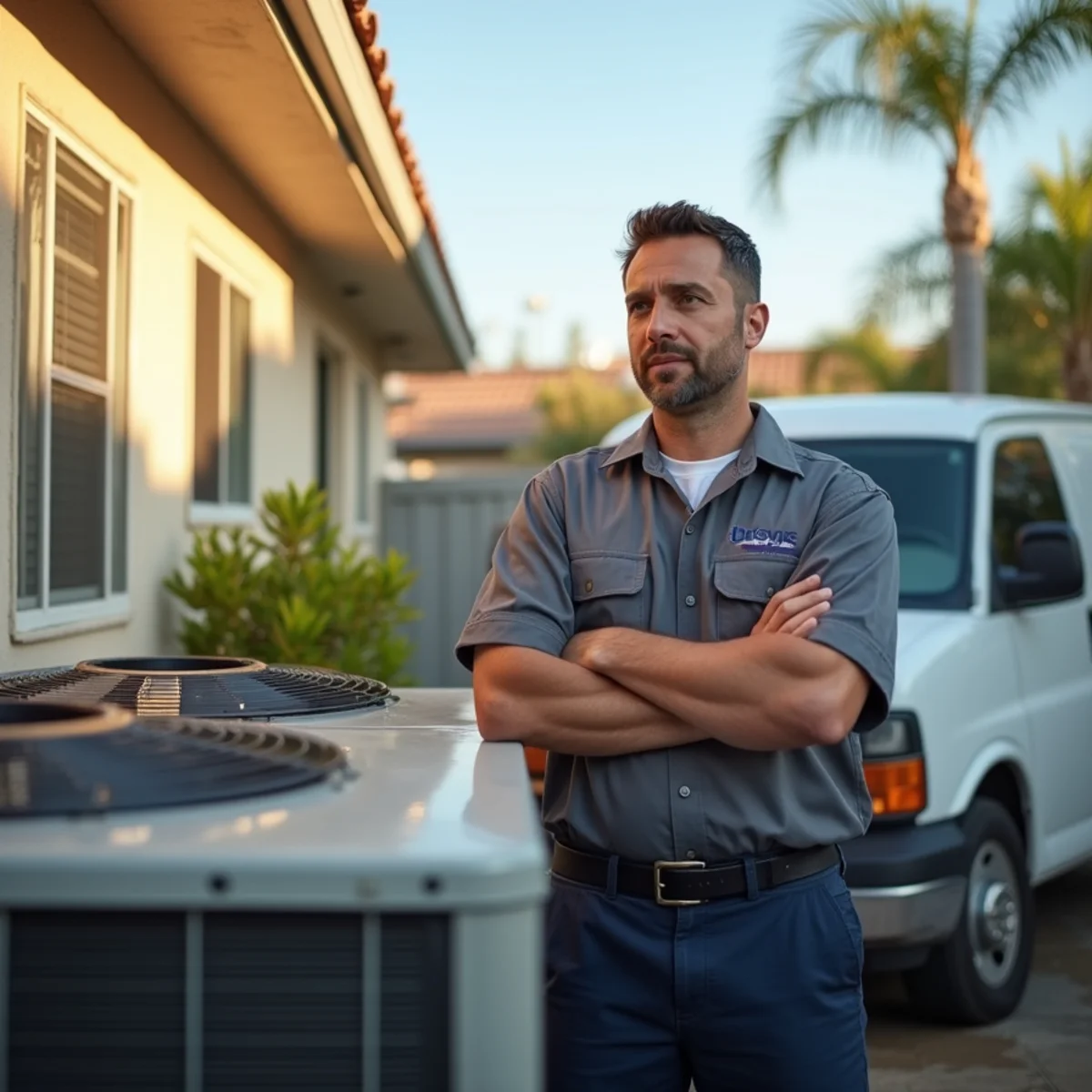
The Poway Whipsaw: Cool Morning, Hot Afternoon
Poway sits in the inland valleys, where the marine layer that keeps the coast mild burns off by late morning. A May or June day can start in the low 60s under June gloom and hit the low 90s by three in the afternoon. That is a 25-to-30-degree swing inside a single day.
For you, that means the AC stays off all morning, then gets slammed on for a hard afternoon run. For the equipment, it means repeated hard starts and long high-load cycles, day after day, through the warm months. The parts that feel it first are the electrical components, and the capacitor leads the casualty list.
What a Capacitor Actually Does
The capacitor is a small cylinder inside your outdoor unit that stores an electrical charge and releases it to jolt the compressor and fan motors into motion. Think of it as the boost that gets heavy motors spinning against inertia every time the system starts.
Every start cycle draws on the capacitor. When your AC kicks on and off repeatedly through a swingy Poway afternoon, that is a lot of starts. Heat compounds the wear. Capacitors are rated for a temperature range, and a condenser baking in direct sun on a 93-degree afternoon runs the internal components far hotter than the air around them.
Hard afternoon heat plus frequent starts is precisely the recipe that dries out and weakens a capacitor before its time.
How to Tell a Capacitor Is Failing
The classic symptom is an AC that hums but will not start, or one where the outdoor fan sits still while the unit tries to run. You may hear a click, then nothing. Sometimes the system starts fine in the mild morning but refuses to run during the hottest part of the afternoon, exactly when you need it.
A swollen or leaking capacitor top is a dead giveaway when we open the panel. Warm air from the vents, longer times to reach the set temperature, and intermittent shutdowns can all trace back to a weak capacitor.
This is not a part to poke at yourself. Capacitors store a charge even with the power off and can deliver a serious shock. Shut the system off at the disconnect and call a technician rather than opening the panel.
The Good News: Capacitors Are Cheap to Fix
A failed capacitor is one of the most common and most affordable AC repairs we make. Catching it early, before it strands the compressor, keeps you in the lower end of the $129 to $1,200 repair range rather than the top.
The danger is ignoring it. A weak capacitor forces the compressor to strain every start. The compressor is the single most expensive component in the system, and running it on a failing capacitor is how a cheap fix becomes a very expensive one. When the outdoor fan will not spin, shut the system down and call before you cook the compressor.
Protecting Your System From the Daily Swing
A programmable or smart thermostat helps enormously. Instead of letting the house heat-soak all morning and then blasting the AC to catch up, a good schedule starts cooling gently before the afternoon peak, which smooths the load and reduces the number of hard starts.
Shade matters too. A condenser in afternoon sun runs hotter than one with some shade, though you must never box it in or block airflow. Keep at least a couple of feet of clearance on all sides and the top clear.
Annual maintenance is the real defense. During a tune-up we test the capacitor under load, measure its microfarad rating against spec, and replace it before it strands you. A capacitor testing weak in spring is a five-minute swap. The same capacitor failing on a 93-degree July afternoon is a no-cool emergency.
Serving Poway and San Diego County Through Every Swing
The daily temperature swing is baked into life in the inland valleys, and it is not going away. What you can control is how ready your system is to handle it. A spring tune-up that catches a weak capacitor is cheap insurance against a summer breakdown.
If your AC is humming without starting, cutting out in the afternoon heat, or you just want it checked before the next Santa Ana pushes temperatures up, call HVAC Poway CA at +1 (327) 210-5999. We offer same-day service in Poway and Sabre Springs and cover San Diego County with 24/7 emergency dispatch.
How the daily swing wears each part, and how a tune-up catches it
| Part hit by the daily swing | How the swing wears it | Caught at a spring tune-up by |
|---|---|---|
| Run and start capacitor | Frequent hard starts plus afternoon heat dry it out | Microfarad test under load against its rating |
| Compressor | Hard starts on a weak capacitor strain it | Amp draw and start-up behavior check |
| Contactor | Repeated cycling pits the contacts | Inspection for pitting and burning |
| Condenser fan motor | Long, hot afternoon runs raise bearing wear | Amp draw and bearing check |
| Refrigerant charge | Expansion and contraction can open slow leaks | Charge measured against the manufacturer target |
Have an HVAC problem in Poway?
Same-day service in Poway & Sabre Springs — 24/7 emergency dispatch countywide.
Frequently asked questions
That pattern usually points to a weakening capacitor or an overheating component. Everything works while the load is light and cool, then fails when the afternoon heat and higher demand push it past its limit. Have it tested before it strands the compressor.